

You walk into a beautifully decorated room and something still feels off. The furniture is great, the colors are right, but the space just doesn’t come together. Nine times out of ten, lighting is the culprit. Lighting shapes how a room feels, how functional it is, and how your decor actually reads to the eye. Yet most homeowners in New York treat it as an afterthought. This guide walks you through every step of selecting fixtures that work hard for both style and function, from auditing your current setup to future-proofing your choices.
Table of Contents
- Assessing your lighting needs and space
- Types of lighting fixtures and their impact
- Matching fixtures to style and decor
- Technical considerations and installation tips
- Final checks: Testing, troubleshooting, and future-proofing
- Our perspective: What most lighting guides miss
- Upgrade your home’s lighting with New Way Ref
- Frequently asked questions
Key Takeaways
| Point | Details |
|---|---|
| Assess your needs | Evaluate each room’s function, size, and current lighting to choose the right approach. |
| Layer lighting types | Combine ambient, task, and accent lighting for balanced style and function. |
| Match style and scale | Choose fixtures that complement your decor and are appropriate for your room’s dimensions. |
| Plan installation carefully | Check wiring, sizing, and safety considerations before installing any light fixtures. |
| Future-proof decisions | Opt for fixtures compatible with smart bulbs and dimmers for straightforward upgrades later. |
Assessing your lighting needs and space
Before you shop for a single fixture, take a close look at what your rooms actually need. Walk through each space at different times of day. Notice where shadows fall, which tasks feel straining on your eyes, and where the light feels flat or harsh. This simple audit saves you from buying fixtures that look great online but fail in your actual space.
Here’s a quick checklist to guide your evaluation:
- Room purpose: Is it a workspace, a relaxation zone, or a social area?
- Room size and ceiling height: These determine fixture scale and mounting style.
- Existing wiring: Know what you’re working with before committing to hardwired fixtures.
- Natural light sources: Windows and skylights affect how much artificial light you actually need.
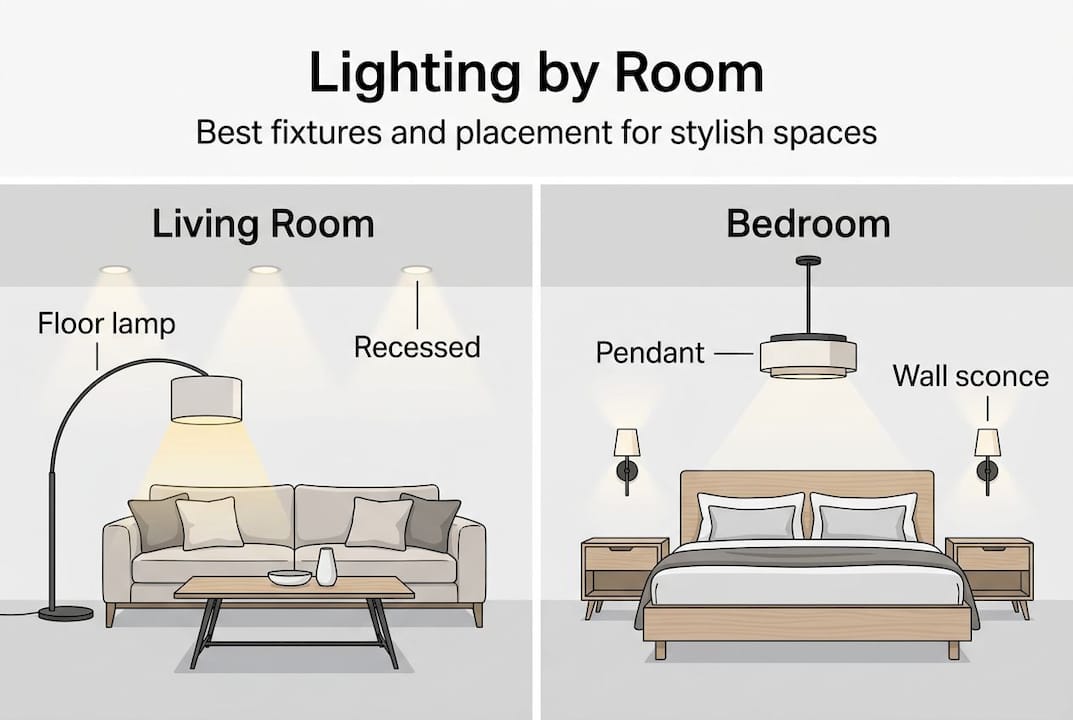
Different rooms require different lighting approaches based on function and layout, which is why a one-size-fits-all approach rarely works. Layering your lighting is the key concept here. Ambient lighting provides general illumination, task lighting targets specific activities like reading or cooking, and accent lighting highlights architectural features or art.
| Room | Recommended fixture | Placement | Lumens needed |
|---|---|---|---|
| Living room | Floor lamp + recessed | Corners + ceiling | 1,500 to 3,000 |
| Kitchen | Pendant + under-cabinet | Island + counters | 3,000 to 4,000 |
| Bedroom | Bedside sconces + overhead | Flanking bed + center | 1,000 to 2,000 |
| Bathroom | Vanity bar + recessed | Mirror sides + ceiling | 1,500 to 2,500 |
For more ideas tailored to compact living, check out these lighting tips for small spaces that work especially well in urban apartments.
Pro Tip: In a New York apartment with limited fixtures, place mirrors across from your main light source and use lighter paint colors on walls. Both strategies bounce light around the room and make the space feel significantly brighter without adding a single new fixture.
Also consider switching to energy-efficient lighting options. LED bulbs use up to 75% less energy than traditional incandescent bulbs and last far longer, which matters when you’re replacing fixtures in multiple rooms.
Types of lighting fixtures and their impact
With your needs outlined, it’s time to understand the fixture types that can fulfill them. Each category serves a distinct purpose and creates a different atmosphere in your space.
Ambient, task, and accent lighting work together to shape the mood and utility of each space. Understanding how each fixture type fits into this system helps you build a layered, intentional lighting plan.
Here’s a comparison of the most common fixture types:
| Fixture | Pros | Cons | Best use |
|---|---|---|---|
| Chandelier | Statement piece, wide coverage | Heavy, needs high ceiling | Dining rooms, entryways |
| Pendant | Focused light, stylish | Limited coverage area | Kitchen islands, bedside |
| Sconce | Space-saving, layered look | Requires wall wiring | Hallways, bathrooms |
| Recessed light | Clean, modern look | Installation can be complex | Kitchens, living rooms |
For a deeper look at how these fixtures work together in a home, explore modern home lighting principles that apply to both new builds and renovated apartments.
Here are the key fixtures to prioritize by room:
- Living room: A central overhead fixture plus at least one floor lamp for layered warmth.
- Kitchen: Recessed lights for general brightness, pendants over the island for task lighting.
- Bathroom: Vanity lighting at eye level to eliminate unflattering shadows.
- Bedroom: Soft overhead light plus bedside task lighting for reading.
“Layered lighting is the single most effective design move you can make in any room. It adds depth, flexibility, and visual interest that a single overhead light simply cannot achieve.”
You can also explore types of lighting fixtures in detail to understand which styles suit different architectural contexts. And for inspiration on how lighting shapes a room’s personality, the guide on lighting in home decor is worth a read.
Matching fixtures to style and decor
Once you know what type of light you need, it’s essential to consider how fixtures will complement your existing decor. A matte black pendant in a room full of warm wood tones can look sharp or jarring depending on how it’s handled. The goal is intentional coordination, not a perfect match.
Cohesive lighting design ties together elements of your decor for a more intentional look. Here’s a step-by-step process to get there:
- Define your interior style. Is your space modern, industrial, Scandinavian, or eclectic? Knowing this narrows your fixture choices significantly.
- Identify your dominant finishes. Look at your hardware, faucets, and furniture legs. Brushed nickel, matte black, and brass are the most common.
- Choose one or two complementary finishes for lighting. You don’t need everything to match, but finishes should relate to each other.
- Consider scale. A tiny pendant in a large dining room looks lost. A massive chandelier in a small bedroom overwhelms.
- Test before committing. Many retailers offer return policies. Order a fixture, live with it for a few days, and assess it in your actual light conditions.
For guidance on choosing fixtures that feel bold without being overwhelming, statement lighting ideas offer practical inspiration. You can also explore how lighting choices affect enhancing home mood throughout your space.
Pro Tip: In compact New York apartments, a single statement fixture, like a sculptural pendant or an oversized floor lamp, acts as a focal point that draws the eye and makes the room feel designed rather than assembled.

For more expert guidance on the selection process, choosing lighting fixtures from Architectural Digest covers the design principles behind coordinating fixtures with your overall interior vision.
Technical considerations and installation tips
With aesthetics chosen, don’t overlook the technical and installation side. A beautiful fixture that’s wired incorrectly or hung at the wrong height can undermine everything you’ve worked toward.
Start by checking your electrical panel’s load capacity. Most standard circuits handle 15 to 20 amps. Adding multiple high-wattage fixtures to a single circuit can trip breakers or create fire hazards. If you’re unsure, consult a licensed electrician before purchasing.
Proper placement and technical understanding ensure optimal lighting effects and safety. Here’s what to verify before you buy:
- Measure ceiling height. Pendants over a dining table should hang 28 to 34 inches above the surface. Chandeliers in open rooms need at least 7 feet of clearance from the floor.
- Check junction box weight rating. Most standard boxes hold up to 35 pounds. Heavy chandeliers require a fan-rated or reinforced box.
- Confirm bulb type and wattage limits. Every fixture has a maximum wattage. Exceeding it is a fire risk.
- Plan for dimmer compatibility. Not all LED bulbs work with every dimmer switch. Check compatibility before purchasing both.
- Account for cord or chain length. Adjustable fixtures give you more flexibility, especially in rooms with non-standard ceiling heights.
“Always switch off the circuit breaker before touching any wiring. If you’re not confident working with electrical systems, hiring a licensed electrician is the safest and smartest move.”
If you’re interested in adding smart controls to your setup, the smart lighting guide explains how to integrate voice control and app-based dimming into your existing fixtures. For a broader overview of the upgrade process, upgrading your lighting from Wirecutter is a reliable resource.
Final checks: Testing, troubleshooting, and future-proofing
After installation, verify your lighting for both performance and adaptability. Turn on every fixture and walk the room. Look for uneven pools of light, dark corners, or areas where shadows fall on work surfaces.
Testing and future-proofing save money and hassle down the line. Common issues and quick fixes include:
- Flickering lights: Usually caused by a loose bulb, incompatible dimmer, or faulty wiring connection. Tighten the bulb first, then check the dimmer compatibility.
- Buzzing sounds: Often a sign of an incompatible LED and dimmer pairing. Swap the dimmer for an LED-rated model.
- Dim output despite correct wattage: Check if the bulb’s color temperature is too warm. A 2700K bulb reads dimmer than a 3000K bulb at the same wattage.
- Uneven coverage: Add a floor lamp or table lamp to fill dark corners rather than replacing the main fixture.
- Shadows on task surfaces: Reposition the fixture or add under-cabinet lighting to direct light exactly where you need it.
Pro Tip: When selecting fixtures, prioritize those with standard E26 base sockets. These are compatible with the widest range of smart bulbs and dimmers, giving you the flexibility to upgrade your lighting system without replacing the fixture itself.
For ongoing inspiration and ideas on how lighting shapes the feel of your rooms, the resource on lighting and ambiance is a helpful reference. You can also browse lighting ideas for every room from HGTV for visual examples of these principles in action.
Our perspective: What most lighting guides miss
Most lighting guides are written for homeowners with full renovation budgets and permanent fixtures. But the reality for many New Yorkers is very different. You’re renting. Your ceiling has one junction box. Your landlord won’t approve hardwired changes. These constraints are real, and most guides simply ignore them.
What actually works for urban apartment dwellers is a flexible, plug-in approach. Plug-in sconces eliminate the need for wall wiring. Portable arc lamps and table lamps can be repositioned as your furniture layout changes. Battery-operated puck lights work under cabinets without any installation at all.
We’ve seen clients transform dark, awkward apartments using nothing but lighting tips for urban apartments and a few well-chosen portable fixtures. The lesson is this: prioritize flexibility over perfection. Choose fixtures that move with you, adapt to new spaces, and don’t require a contractor to install. That mindset will serve you far better than chasing the ideal permanent setup in a space you may not stay in forever.
Upgrade your home’s lighting with New Way Ref
Ready to apply what you’ve learned? Finding the right fixtures doesn’t have to mean hours of searching across dozens of sites. At New Way Ref, we’ve thoughtfully curated a selection of modern lighting fixtures and home decor that balance style with real-world functionality.
Whether you’re looking for a statement pendant for your living room or a sleek sconce for your bedroom, our home decor selection covers a range of styles and price points. Browse the full lighting fixtures at New Way Ref collection and find pieces that work for your space, your style, and your budget. Free shipping on orders over $50 makes it even easier to get started.
Frequently asked questions
What are the three main types of home lighting?
Home lighting is generally divided into ambient, task, and accent types, each serving a distinct purpose in creating a functional and visually balanced room.
How do I choose the right size light fixture for my room?
Fixture sizing should match room dimensions and ceiling height, so measure both before selecting a pendant drop length or chandelier diameter.
What features help future-proof my lighting choices?
Smart and modular lighting options offer the best adaptability, so look for fixtures with standard E26 sockets that accept smart bulbs and work with dimmer switches.
Can I mix lighting styles in one room?
Yes, mixing complementary lighting styles can create a layered design, as long as the finishes relate to each other and the overall scale stays balanced.
What is the quickest way to improve a room’s lighting?
Adding a bright floor lamp or swapping outdated shades for lighter ones can immediately boost both the light level and the visual style of any room.